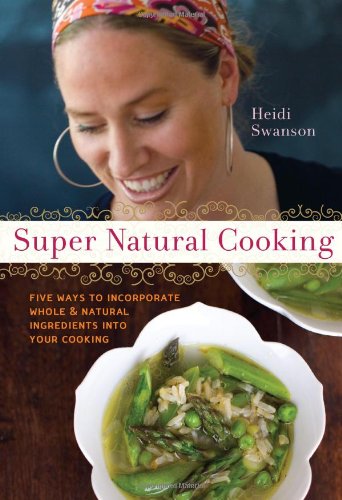
Super Natural Cooking: Five Delicious Ways to Incorporate Whole and Natural Foods into Your Cooking

Product Details
Everyone knows that whole foods are much healthier than refined ingredients, but few know how to cook with them in uncomplicated, delicious ways. Using a palette of natural ingredients now widely available in supermarkets, SUPER NATURAL COOKING offers globally inspired, nutritionally packed cuisine that is both gratifying and flavorful. With her weeknight-friendly dishes, real-foodie Heidi Swanson teaches home cooks how to become confident in a whole-foods kitchen by experimenting with alternative flours, fats, grains, sweeteners, and more. Including innovative twists on familiar dishes from polenta to chocolate chip cookies, SUPER NATURAL COOKING is the new wholesome way to eat, using real-world ingredients to get out-of-this-world results.
- ISBN13: 9781587612756
- Condition: New
- Notes: BUY WITH CONFIDENCE, Over one million books sold! 98% Positive feedback. Compare our books, prices and service to the competition. 100% Satisfaction Guaranteed
Customer Reviews ::
Not quite traditional foods, but tasty - jobert - Chicago, IL
I've followed Heidi's blog via email updates for about a year now. I have made a few recipes from there, and I picked this book up at the library.
As other reviewers have noted, she has gorgeous photography, and her instructions are clear and helpful. She is artful in her use of the English language, I must say. She is my go-to source for tasty and creative vegetarian dishes. I should mention that I am not a vegetarian, although probably a third to half of the meals I eat each week are. (I did experiments with going veg that didn't work out for me, because I seem to really need animal protein to be healthy.) I do genuinely think veg food is tasty, but I don't think it is a healthy diet for everyone.
So why three stars?
PROS:
-She stresses using organic, quality, whole ingredients. That is essential, in my mind, for healthful cooking.
-She doesn't stray from saturated fats. Thank goodness! I was so glad to see that Heidi isn't part of the anti-saturated fat campaign. If you are skeptical, and believe that saturated fats are terrible for you, google the "diet heart hypothesis" and "women's health initiative" and you will see that in the past few years, research studies are showing that a diet low in saturated fat actually doesn't reduce your risk of heart disease or cancer. Even more interesting is that the whole idea was built on shaky use of data to begin with. Google "Ancel Keys".
-Did I mention Heidi is an amazing photographer?? I want to eat the pictures.
CONS:
-Heidi does a lot of innovative work, and these recipes are testament to that. However, some of her methods aren't based on traditional cooking techniques. For example, there is phytic acid in whole grain flour (wheat, rye, etc). Phytic acid blocks nutrient absorption and causes other digestive issues over time. I am not going to go into a lot of detail, but it is important for flour to either be soaked before it is used (like the teff flour she mentions from Ethiopia--they always ferment it for a few days to make injera bread in Ethiopia), or the grains should be sprouted and then thoroughly dried before they're ground into flour. I didn't see evidence of her mentioning that in the book. (If I'm wrong, I would appreciate someone pointing that out.)
-This may draw the ire of some vegetarians, but I have read a lot about soy foods being harmful to one's health. As a woman in my child-bearing years, I have chosen to remove soy foods from my diet, even though I had a happy love affair with tofu for a long time. Soy foods can mess with your hormones, ladies. I think traditionally speaking, soy was fermented or specially prepared to be consumed in smaller quantities (miso, soy sauce). And we generally eat a lot of soy here, either knowingly as vegetarians or often unknowingly in processed foods. So recipes in this book that are soy heavy, I just skip. That is a bummer. (And again, I recommend googling the subject for more info.) After I went totally organic in dairy and meat, and cut the soy out of my diet, my menstrual cycle is like clockwork now. Sorry if that is TMI, but it's true. This is after 14 years of it being unpredictable.
So I give three stars to this book. What I do is take what I've learned about traditional food preparation methods (i.e. soaking flour/sprouting grain, etc) and incorporate those practices into these recipes to have something tasty and healthful--in a way that has stood the test of time. It's a win-win: healthy preparation + awesome Heidi taste!
For more info on traditional food preparation, I recommend Nina Planck or Michael Pollen books for the theory, or Nourishing Traditions for the practicality.

No comments:
Post a Comment